This was then . . .  This is now . . . . .

 This is now . . . . .


January 24, 2011 (Breakpoint.org) - You have probably never heard of Lothar Kreyssig—I hadn’t until recently. Yet, after hearing his story, I realized Kreyssig was a hero for our times: a man whom, at almost unbelievable risk, stood up for the sanctity of human life.
In October, 1939, the Third Reich created what came to be known as the “Action T4” program. In furtherance of what the Nazis called “racial hygiene,” Reich bureaucrats, working with doctors, were authorized to identify and kill those deemed to be “unworthy of life,” that is, institutionalized patients with “severe disabilities.”
Of course, expressions like “unworthy” and even “severe” are subjective. In reality, they were a license for mass murder. Hitler called for at least 70,000 people to be killed under this program, so doctors and officials set about meeting the Fuhrer’s quotas.
Fearing domestic and international reaction, the Nazis tried to hide what was going on: they lied to patients’ families and, fore-shadowing Auschwitz, they disguised the gas chambers as showers.
When I think of what happened to those people, especially the children—some like my autistic grandson, Max—it breaks my heart—horrifies me.
The Nazis also took pains to provide a patina of legality to the murders: Hitler personally ordered German judges not to prosecute doctors for killing their patients. And that’s where Kreyssig comes in: He was a highly regarded judge in his native Saxony.
But he was more than a judge—Kreyssig was a leader in the Confessing Church, which resisted the Reich’s efforts to “Nazify” protestant churches. To be a Confessing Churchman, never mind a leader, was to live with a bull’s-eye painted on your back.
As more and more death certificates for mentally ill people crossed his desk, Kreyssig realized that something terrible was happening.
He wrote the Reich Minister of Justice protesting not only the Action T4 program but also the treatment of prisoners in concentration camps. He then charged a doctor with murder in connection with the deaths of his patients.
When he was called into the Minister’s office, where he was told that Hitler himself had authorized the program. To which Kreyssig replied: “The Führer’s word does not create a right.”
The courage to say that to a government official in Nazi Germany was extraordinary. Kreyssig was forced to retire. Although the Gestapo tried to get him sent to a concentration camp, fears over drawing attention to the T4 program probably saved Kreyssig’s life.
He spent the rest of the war at home tending to his farm and, oh yes, hiding Jews on his property.
The only judge to stand up to the Nazis outlived the “1000-year Reich” by forty-one years. Twenty years after his death, Germany held a memorial honoring his bravery and compassion.
In a culture where “go along to get along” was literally a survival strategy, Kreyssig refused to be silent. When the majority of German Potestants adapted the faith to the demands of the Reich, he refused to go along and made it clear that there was a higher law.
January 24, 2011 (Breakpoint.org) - You have probably never heard of Lothar Kreyssig—I hadn’t until recently. Yet, after hearing his story, I realized Kreyssig was a hero for our times: a man whom, at almost unbelievable risk, stood up for the sanctity of human life.
In October, 1939, the Third Reich created what came to be known as the “Action T4” program. In furtherance of what the Nazis called “racial hygiene,” Reich bureaucrats, working with doctors, were authorized to identify and kill those deemed to be “unworthy of life,” that is, institutionalized patients with “severe disabilities.”
Of course, expressions like “unworthy” and even “severe” are subjective. In reality, they were a license for mass murder. Hitler called for at least 70,000 people to be killed under this program, so doctors and officials set about meeting the Fuhrer’s quotas.
Fearing domestic and international reaction, the Nazis tried to hide what was going on: they lied to patients’ families and, fore-shadowing Auschwitz, they disguised the gas chambers as showers.
When I think of what happened to those people, especially the children—some like my autistic grandson, Max—it breaks my heart—horrifies me.
The Nazis also took pains to provide a patina of legality to the murders: Hitler personally ordered German judges not to prosecute doctors for killing their patients. And that’s where Kreyssig comes in: He was a highly regarded judge in his native Saxony.
But he was more than a judge—Kreyssig was a leader in the Confessing Church, which resisted the Reich’s efforts to “Nazify” protestant churches. To be a Confessing Churchman, never mind a leader, was to live with a bull’s-eye painted on your back.
As more and more death certificates for mentally ill people crossed his desk, Kreyssig realized that something terrible was happening.
He wrote the Reich Minister of Justice protesting not only the Action T4 program but also the treatment of prisoners in concentration camps. He then charged a doctor with murder in connection with the deaths of his patients.
When he was called into the Minister’s office, where he was told that Hitler himself had authorized the program. To which Kreyssig replied: “The Führer’s word does not create a right.”
The courage to say that to a government official in Nazi Germany was extraordinary. Kreyssig was forced to retire. Although the Gestapo tried to get him sent to a concentration camp, fears over drawing attention to the T4 program probably saved Kreyssig’s life.
He spent the rest of the war at home tending to his farm and, oh yes, hiding Jews on his property.
The only judge to stand up to the Nazis outlived the “1000-year Reich” by forty-one years. Twenty years after his death, Germany held a memorial honoring his bravery and compassion.
In a culture where “go along to get along” was literally a survival strategy, Kreyssig refused to be silent. When the majority of German Potestants adapted the faith to the demands of the Reich, he refused to go along and made it clear that there was a higher law.
Islamic Jew hatred. It's what drives the genocide of the Jews in the Muslim world today. It's what drove the Muslim world in their partnership with Hitler, and it fueled the oppression, humiliation, and slaughter of the Jews throughtout Islamic history.
The role of the Mufti and the Muslim world in World War II has been whitewashed from history. Why? So that they might rise again to commit the same unspeakable, horrific crimes againt humanity?
Haj Amin al-Husseini should have been executed at Nuremberg. Instead, he was given the same status of The Jewish Agency at the UN in 1947, when it was debating the partition of the Jewish State, despite the stunning evidence (documents, files, etc.) against him (outlined here) and presented to the UN.
According to testimony by Nazi war criminals, the Mufti's influence was critical to the German decision to annihilate the Jews of Europe. At the Nuremberg Trials in July 1946, Eichmann's deputy Dieter Wisliceny (subsequently executed as a war criminal) testified: (here)
"The Mufti was one of the initiators of the systematic extermination of European Jewry and had been a collaborator and adviser of Eichmann and Himmler in the execution of this plan... He was one of Eichmann's best friends and had constantly incited him to accelerate the extermination measures. I heard him say, accompanied by Eichmann, he had visited incognito the gas chambers of Auschwitz."
Now we find that the Nazis promised the leader of the Muslim world, Haj Amin al-Husseini, leadership of Palestine after slaughter of its Jews, according to a US report.
I have long been reporting on the deep ties between the leader of the Muslim world, Haj Amin al-Husseini, and Hitler and the Third Reich. Scroll here: Islam: Instigator, Originator, Collaborator of the Final Solution.
The "peace process" is a lie. The Muslim world cannot and will not accept Israel under any circumstances. The "peace process" is Jewish surrender to Isalm in installments.
Flashback: Then-leader of the Muslim world, Mufti Haj al-Husseini:
In 1943, the Mufti traveled to Bosnia, where he helped to raise a Bosnian Muslim Waffen-SS Hanjar, who slaughtered 90 percent of the Jews in Bosnia…Other Bosnian Muslim units raised by the Mufti were sent to Croatia and Hungary, where they participated in the killing of Jews.
Husseini and Himmler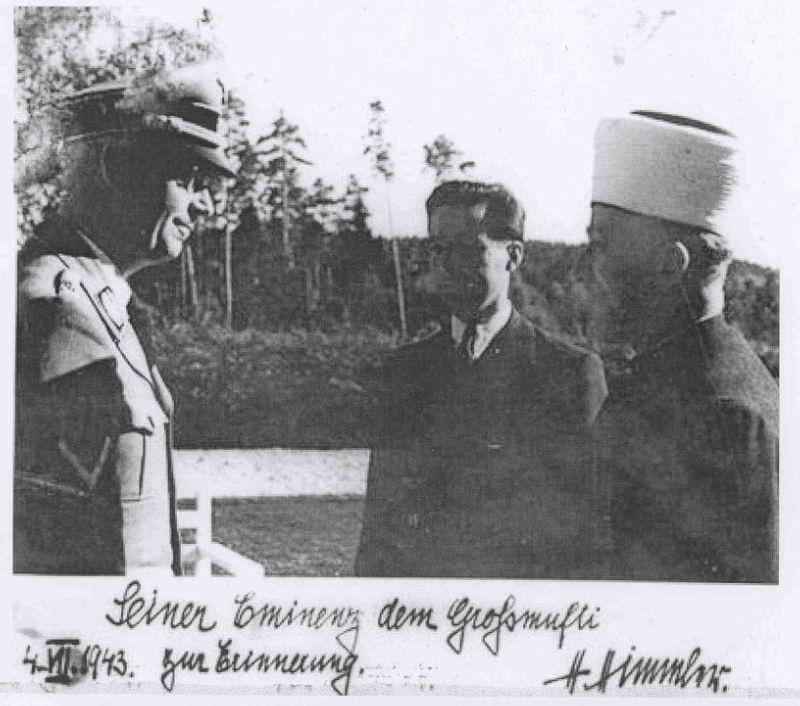

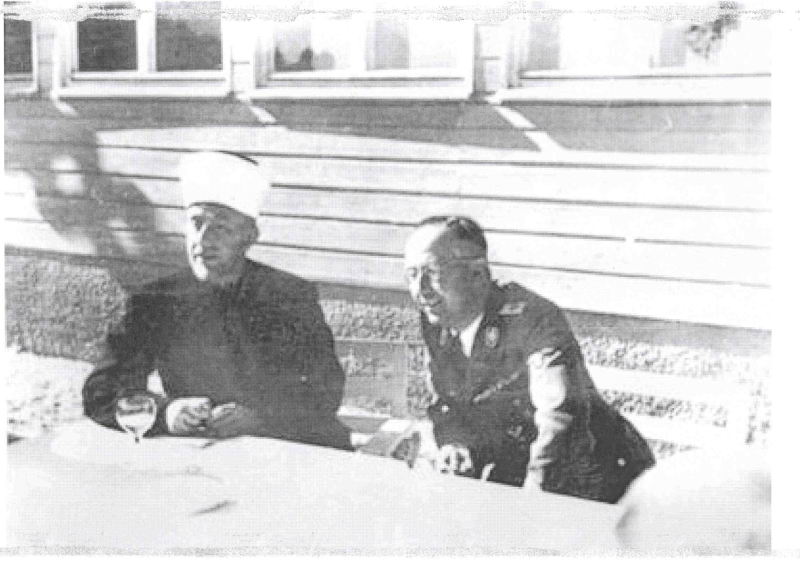
Wine with Husseini and Himmler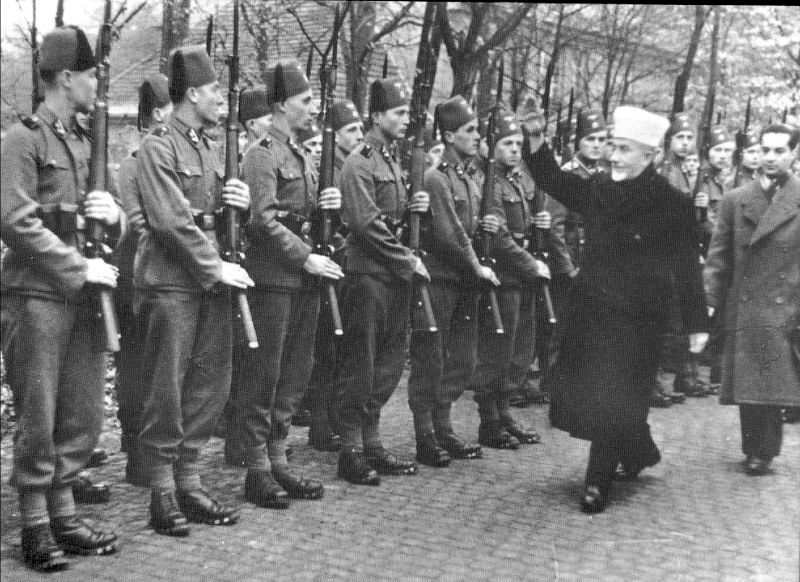
Muslim Armies under Husseini for Hitler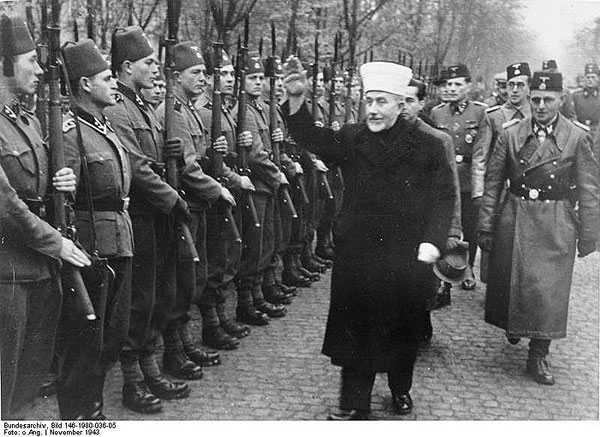


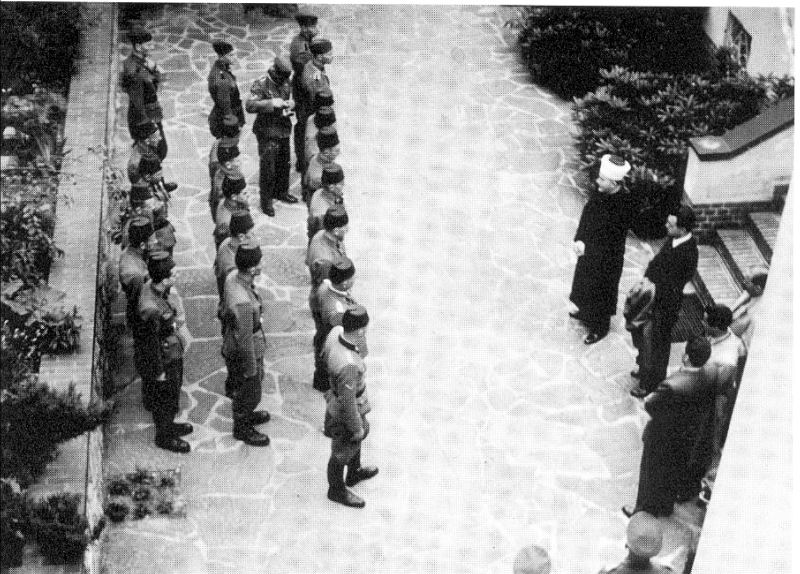
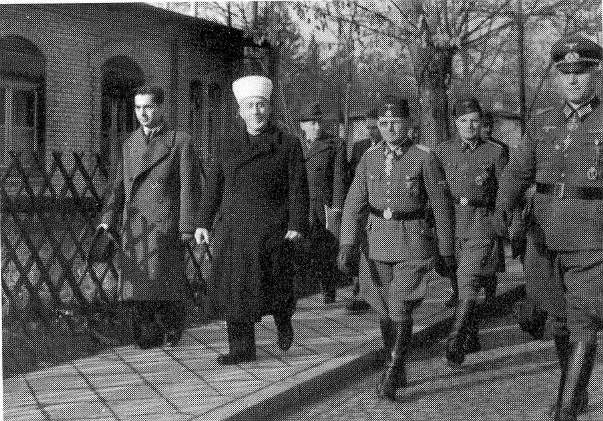
NEW YORK – A newly released report by the US National Archives details the close collaborative relationship between Nazi leaders and the grand mufti of Jerusalem, Haj Amin al-Husseini, indicating that Nazi authorities planned to use Husseini as their leader after their conquest of Palestine.
Husseini was paid handsomely by the Nazis for his efforts, recruited Muslims for the SS and was promised that he would be made Palestine’s leader after its Jewish population of 350,000 had been murdered.The report, Hitler’s Shadow: Nazi War Criminals, US Intelligence and the Cold War, was prepared on the basis of thousands of documents declassified under the 1998 Nazi War Crimes Disclosure Act.
\Husseini’s CIA file, the report states, indicates that wartime Allied intelligence organizations gathered a “healthy portion” of the incriminating evidence against him.
“Hitler’s Shadow” is an addendum to a 2004 US government report, US Intelligence and the Nazis.
The new report’s authors, Norman J.W. Goda of the University of Florida and Richard Breitman of American University, said the addendum was particularly important.
“We thought the information was significant and detailed,” Breitman told The Jerusalem Post regarding the newly uncovered facts on the Jerusalem mufti in particular.
“We thought the April 1945 contract between the [German] Foreign Office and Husseini was striking evidence of an ideological collaboration both sides hoped would continue after the war.”
Husseini, who died in Beirut in 1974, was apparently paid 50,000 marks per month, and 80,000 additional marks a month for living expenses, according to a contract with the Germans. This was a time when a German field officer typically earned 25,000 marks a year.
According to the report, on November 28, 1941, Adolf Hitler told Husseini that the Afrika Korps would “liberate” Arabs in the Middle East and that “Germany’s only objective there would be the destruction of the Jews.”
“SS leaders and Husseini both claimed that Nazism and Islam had common values as well as common enemies – above all, the Jews,” the report states.
In fall 1943, it says, Husseini went to the Croatia, a German ally, to recruit Muslims for the Waffen-SS.
“During that trip he told the troops of the newly formed Bosnian-Muslim 13th Mountain Waffen-SS division that the entire Muslim world ought to follow their example,” the report states.
Husseini also organized a 1944 mission in which Palestine Arabs and Germans would carry out sabotage and propaganda after German planes dropped them into Palestine by parachute.
“Husseini insisted that the Arabs take command after they landed and direct their fight against the Jews of Palestine, not the British authorities,” according to the report.
As late as 1945, the German Foreign Office rewrote its contracts with Husseini.
At that point, the outcome of the war was no longer in question, and therefore the contracts are significant as indications of Nazi intentions to work with the mufti in future political-ideological campaigns in Arab lands.
In October 1945, the report said, the British head of Mandatory Palestine’s Criminal Investigation Division told the US assistant military attaché in Cairo that the mufti might be able to unite Palestine’s Arabs and “cool off the Zionists. Of course, we can’t do it, but it might not be such a damn bad idea at that.”
This evidence “is significant in light of Husseini’s lenient postwar treatment,” the report notes. Husseini was allowed to flee to Syria after the war despite enough evidence to bring him to trial as a war criminal.
“Together, the Army and CIA records will keep scholars of World War II and the Cold War busy for many years,” the report’s authors conclude.
Grass stirred worldwide controversy when he admitted that he had been a member of Hitler's notorious Waffen SS in the final months of World War II. Having set himself up for decades as his country's moral conscience, in which capacity he was always urging his fellow countrymen to “come clean” about their wartime past and seek forgiveness, the moralizing Grass stood revealed as a hypocrite of colossal proportions.
But the timing of Grass’s confession is not inexplicable. It appears to be a cynical public relations ploy to promote sales of his forthcoming autobiography, Peeling the Onion. Hence Grass made his startling disclosure in a two-page interview with the Frankfurter Allgemeine Zeitung, one of Germany's leading national newspapers. The first print run of his book has since sold out.
Grass’s revelation adds a new twist to the personal narrative he has carefully fashioned over the years. Heretofore, the conventional wisdom had it that Grass, like many of his generation, was drafted into the Nazi army, the Wehrmacht, serving as an anti-aircraft soldier, but was in no sense a true-believer in the Nazi cause. Grass did nothing to discourage the prevailing view and much to bolster it. He had long stressed that he and other German youth were “too young to have been a Nazi, but old enough to have been formed by the Nazi regime.”
Grass now tells a different story. Though he maintains that he was drafted into the 10th SS Panzer Division “Frundsberg,” part of the Waffen SS, serving from September 1944 until the war's end, he now concedes that “Germans joined with enthusiasm and with popularity.” Grass further says that he himself had eagerly volunteered to join the Nazi U-boat fleet, only to be rejected due to his young age. And so far from rebelling at the idea of SS service, Grass says he considered joining the SS the ideal career move, thinking the elite military units would both provide him with an exit from his despised bourgeois home and a direct route to Hitler, to whom the teenaged Grass remained loyal until the Nuremberg war crimes trials.
At first blush, Grass’s conversion from SS man and Hitler admirer to leftist icon and relentless foe of capitalism, German bourgeois society and especially America, may seem incongruous. But as German commentator Jens Jessen, writing in the newspaper Die Zeit, notes, there is a common thread underlying his political weltanschauung. Jessen writes that in his work "Grass points out with verve the anti-bourgeois attitude of the Nazis" and the fascination of the Nazi 'Volksgemeinschaft' (people's community), in which there are no ‘class differences and religious darkness.’” At 78 years of age, Jessen darkly comments, the Nobel laureate still appears like someone “who could again immediately fall into another ideology if only it were anti-bourgeoisie enough and promised an end to the class society.”
Nor is that the only link between Grass’s ardently leftist present and his Nazi past. For instance, there is his strident contempt for Catholicism and the authority of the Catholic Church -- a driving theme in the Nazi persecution of German Catholics. It was a contempt that manifested itself most sharply in the 1950s, when Grass, then in the dawn of his international celebrity, tirelessly maligned the conservative Chancellor of West Germany Konrad Adenauer, a Catholic. Grass unabashedly regarded Adenauer as a worse evil than the Nazis who preceded him in power. Recalling the era, Grass once sneered, “We were under Adenauer, ghastly, with all those lies, with all that Catholic fug. The society of that day was fed by a kind of stuffiness that never existed under the Nazis." Similarly, Grass ridiculed Adenauer for exhibiting what he called a “philistinism [that] hadn't existed even under the Nazis.” As Jessen observes, such utterances suggest that Grass never freed himself "from the hocus-pocus of Nazi propaganda.”
It’s certainly true that the passage of time has not made Grass appreciably less susceptible to the allure of authoritarian rulers, even if left-wing dictators have replaced the Fuehrer in the spotlight of his imagination. In the 1980s, Grass happily sang the praises of the Sandinista regime in Nicaragua, blaming it’s eventual downfall on his preferred bête noire, the United States. Not a Communist in his own right, Grass nonetheless found that he had no difficulty making the Soviet Union’s case when the United States proposed to deploy cruise missiles in Germany to defend the country against Soviet SS-20 ballistic missiles. “A people that fifty years later is still suffering the consequences of its failure to resist Hitler’s seizure of power ought to have learned to recognize different but comparable dangers before it is too late and thus look upon the right to resist as a democratic imperative,” Grass intoned in 1987. Thus did the United States become, for Grass, the effective successor of the Third Reich.
Communist Cuba, on the other hand, earned his admiration. As late as 1993, when well-documented tales of Castro’s terror had thinned the ranks of his apologists, Grass was still touting the glories of the revolution, claiming that Cubans “were less likely to notice the absence of liberal rights” owing to the “self-respect” they had purportedly gained. Most famously, Grass nursed an abiding affection for communist East Germany, becoming a leading opponent of German unification. Unwilling to see the GDR join the West, with its abominable capitalism, Grass cleaved to the dream of a confederation of two German states, a “third way” that allowed him to indulge his hopes for a socialist utopia that history had denied. Parallels to Grass’s Nazi youth were unmistakable. Just as Nazi propaganda captivated him in his youth, so the socialist vision was now too appealing to surrender.
German voters suffered from no similar delusions. They unanimously voted to make Germany whole. Grass was unmoved. Instead of deferring to the wishes of his countrymen, the novelist took to mercilessly savaging post-unification Germany. It was, he claimed, eternally tainted by the atrocities of Nazi Germany. Worse yet, by allying itself with the West, and particularly the United States, Germany had lost its “essential substance.”
Here again Grass betrayed something of his former self. Once a soldier in the Nazi quest for Germanic racial purity, Grass now demanded that Germany adhere to an economic and cultural purity, one in accordance with his socialist dreams and his contempt of the United States. Paul Hollander once wrote that “[f]or Grass, as for many other critics, the rejection of the United States and the rejection of his own society became intertwined; he detested West German society primarily because it was becoming Americanized, that is, materialistic, greedy, and polluted physically as well as spiritually.” German unification merely fanned the flames of his hatred.
Neither the terrorist attacks of September 11 nor the U.S.-led “War on Terror” have prompted a change in his thinking. On the contrary, Grass’s disdain for the United States has, if anything, only increased in recent years. In a 2003 op-ed for London’s Guardian, Grass accused the United States of inventing the threat of terrorism. “We know how people create enemies where none exists,” Grass wrote. The only serious threat to world peace, Grass held, came from the United States and its president: “It [the US] stands there in its hubris, unashamed and dangerous to the rest of the world. The current US president is the perfect expression of this common danger we face.”
Insofar as Grass acknowledges the reality of terrorism, he reposes the blame squarely on the United States. In a 2003 interview with the German newsmagazine, Der Spiegel, Grass lectured that “the deep reason for the increasing terrorism” was “disappointment” born of poverty. Informed that the September 11 hijackers hailed from wealthy backgrounds, Grass refused to budge. “In any case,” he retorted, “war is the wrong reaction to terrorism.”
On this point -- America’s supposed culpability for worldwide terrorism -- Grass has stayed consistent. In a June address before the annual International PEN Congress, an international association of writers, Grass made a point of inveighing against “the hubris of the world's only superpower” and professed his indignation that “[a]rmed force is used by this superpower to defeat the terrorism it is itself responsible for.” Grass then appealed for the United States to be viewed in its appropriate light: as the moral equal of terrorists everywhere. “Although we meticulously keep count of the victims of terror attacks, terrible though their number is, nobody bothers to count the dead caused by American bombs or rocket attacks,” Grass groused.
Coming from an admitted member of the Waffen SS, such moral equivalence may seem beyond perverse. Yet it is entirely characteristic for the world-famous intellectual who migrated from one political extreme to the other without the intervention of reflection and who has remained faithful to only one guiding idea--that the West, as symbolized by the United States, is always in the wrong.
In the gloaming of his career, it would be unrealistic to expect Grass to reconsider the convictions that have cemented his reputation as a writer and, less deservedly, a political prophet. It is doubtful, in any case, that he is open to persuasion. Reflecting on his support East Germany in the late 90s, Grass maintained that whatever else was recorded by history, he had been right to take his stand with communist tyranny. “I believe it is a good thing that a writer does not sit on the side of the victors,” said Grass. From his time in the service of the SS to his decades-long romance with communist regimes, it is indeed the one thing of which Grass can never be accused.
Stephen Brown is a columnist for Frontpagemag.com. Jacob Laksin is a senior editor for Frontpagemag.com.
 Adolf Hitler's Mein Kampf was a work which contained evolutionary racism.[1] In his work Mein Kampf, Hitler wrote of "Monstrosities halfway between man and ape" and decried Christians going to "Central Africa" to set up "Negro missions," which Hitler stated resulted in the turning of "healthy . . . human beings into a rotten brood of bastards."[2]
 Adolf Hitler also wrote the following evolutionary racist statement in Mein Kampf:
"The stronger must dominate and not blend with the weaker, thus sacrificing his own greatness. Only the born weakling can view this as cruel, but he, after all, is only a weak and limited man; for if this law did not prevail, any conceivable higher development (Hoherentwicklung) of organic living beings would be unthinkable."[3]Charles Darwin was also an evolutionary racist.[4][5]
Prominent evolutionist Richard Dawkins stated:
“What’s to prevent us from saying Hitler wasn’t right? I mean, that is a genuinely difficult question."[6]


